Thursday, April 5, 2007

Yahoo.360.com Archive - Part 1

Wan Empuk dan Wan Malini dari Bukit Siguntang– Are they for real?

No lah, bukan bekas gefren2 saya la, ex-schoolmates pun bukan, tho classmate dulu ada lah sorang nama wan. Tapi tu Wan Amizah. Dua-dua Nek Wan ni sebenarnya asalnya dari Bukit Siguntang and hidup lebih 700 tahun dulu, too long before my time lah. Dulu masa kecik-kecik, I used to read the story of Wan Empuk and Wan Malini, possibly from a manuscript of Sejarah Melayu; ntahla, tak ingat sangat. Masa tu mana ada Doraemon, Dooms pun takder to be keep me occupied. Internet lagi la jangan harap. So Wan Empuk ngan Wan Malini lah yang buat budak ni dok rumah.


Pada malam itu, dipandang oleh Wan Empuk dan Wan Malini dari rumah mereka, di Bukit Siguntang bernyala-nyala seperti api. Maka kata Wan Empuk,”Cahaya apa gerangan bernyala-nyala itu? Takut pula beta melihat dia.” Maka kata Wan Malini, “Jangan kita ingar-ingar; kalau-kalau gemala naga besar gerangan itu.” (Kisah Raja-raja Melayu Singapura, Agus Salim, Edisi Kedua, 2004)


Hehehe, asyik dengan gerangan je! Yalah, bahasa dulu-dulu, kan brother?


Kalau ikut citer Tun Sri Lanang, padi huma yang ditanam oleh Wan Malini dan Wan Empuk ni tiba-tiba berbuah emas, berdaun perak dan batangnya dari tembaga suasa, bila tiga mamat dari India datang ke Bukit Si Guntang. Tiga mamat ni bukan sebarang mamat. Depa ni anak-anak Raja Suran (Maharaja Hindi; anak dia dengan Permaisuri Mahtabul Bahari dari Amdan Negara, yang kononnya generasi ke tiga belas dari Iskandar Zulkarnain dengan bini India dia (bollywood lah tu!), Puteri Shahrul Bariah), datang ke Bukit Siguntang naik Lembu Putih (sure berkilat punya la brother).

  • Sang Nila Pahlawan - kawin Wan Empuk. Nila Pahlawan became ruler of the Minagkabau lands in Sumatra Barat

  • Krishna Pendita - kawin Wan Malini, ruled Tanjung Pura in Sumatra Utara

  • Nila Utama – kawin Wan Sendari, became ruler of Palembang, dapat anak Sang Nila Utama


Ha, si Parameswara yang kemudiannya dikenali sebagai Megat Iskandar Shah, tu keturunan Nila Utama la. Anak Nila Utama, Sang Nila Utama tu yang bukak Temasek/Singapore and memerintah dari 1299 ke 1347. Bukan Sir Stamford Raffles, dik oooi. Engko belajar kat mana tu, nak? Dari depa ni lah salasilah keturunan raja-raja melayu ni datang, notably kesultanan Melaka, and kesultanan Perak.


Tapi teman heran jugak, apase kena putera2 Hindi tu nak mai Bukit Siguntang? I guess masa dulu, we looked up to India, yalah masa tu I guess orang2 ugama Hindu kan and tamaddun depa besar. Tapi takder ke pemuda-pemuda hencem dari Ampang ke yang pegi ke Bukit Siguntang ngorat Wan Empuk ngan Wan Malini yang keturunan mereka nanti akan memerintah dari masyrik ke magrib kepulauan Melayu ni? Yalah kut-kut Panjang anak Bulat yang mai naik sampan dari Kukup sampai Palembang ikut Sungai Musi. (Waduh-waduh, nggak glamer pak Rahman, harus dari Bollywood ini! Tapi kalau Shah Rukh Khan datang, baru ngetop.) Habih la the two ladies got swept off their feet. Ni macam budak-budak pompuan sekarang, baru mamat Bangla datang dah terbeliak bijik mata! Hahaha, nothing against the MatBanglas la brother. Saja suka-suka nak ngutuk je.

Palembang in the old days

Teman dah pegi Palembang banyak kali – in fact my first ever trip to Indonesia was to Palembang. Tak der la apa nak citer sangat Palembang ni. Sungai Musi ni memang besar lah, bukan macam sungai Kelang yang macam longkang tu, tapi the town proper is a bit non-descript (maaf lah Pak Irvan (Airlangga), saya suka juga pergi ke kilang bapak di Plaju, tapi nggak ada sebarang untuk saya liburan di Palembang). I tried venturing out on foot to see if there were old museums or palaces or what-ever remnant of them. Habuk pun tak der. I can’t see anything to say that this was the place where the old Raja-raja Melayu originates. Betui ke ni Tun Sri Lanang apa yang engko citer ni? Padi huma kat Bukit Siguntang pun orang tak tanam. As one writer (Nisah Haron Online) from Negeri Sembilan puts it, “mungkin kita sudah terlalu dikhayalkan dengan kisah-kisah Wan Empuk dan Wan Malini dan keturunan Raja-raja Melayu yang kononnya berasal dari sini.” Atau kita sebenarnya asyik dilagukan oleh Si Oh Fatimah, (lagu A Ramli) yang juga berasal dari Palembang jugak (Oh Fatimah, gadis Palembang, pinggangnya ramping, leher jinjang…). Hmmm, may be that was the description of Wan Empuk and Wan Malini, sampai 3 putera raja ni tak balik2 dah ke India.

Palembang from the air with the Ampera Bridge and the Sungai Musi dominating the view. I used to walk along the riverbank with my then boss Weimin, a Chinese American. We came across a market; so Weimin asked me to buy him a papaya since I can speak the local language hence I can esaily bargain. So I approached the old lady selling papaya, "Bu, berapa ya betik ini?" I asked her. "200 rupiah, nak," she replied. (it was 20 Malaysian cents) I looked at Wemin, telling him that under no circumstances I will bargain with the old lady. In fact I gave her extra. Life was difficult there.

Ntah ler. Saya bukan sejarahwan, ahli arkeologi pun tak. Dulu masa F1 ada ler berangan nk jadi ahli arkeologi, tapi masa F5, tak nampak pun kursus arkeologi untuk pegi luar negeri, so kensel la. Hahaha, tapi to be honest I am not too worried if our sultans were from Palembang, unlike Nisah Haron. If so, so be it. Kalau tak pun, sowwhat? Kalau dulu depa boleh bangunkan Empayar Sri Wijaya, then they must have done something right. I am more concerns about the claims that they were descendent of Raja Suran, and that Raja Suran were descendent of Alexander the great and his Indian wife! Ni kena study lagi. First, sapa Raja Suran ni? Wujud ke dalam sejarah India? Tak famous pun, must be an obscure Raja. Babur ke Jahangir ke, tau lah jugak teman; Shah Jahan ngan Akbar tu tak tau saja la. Lagipun, the kurun in question, India diperintah oleh Delhi Sultanate (1206-1526) dah citer Nek Wan kiter ni around that time frame la, so India dah Islam dah masa tu. Tapi setau kiter bila Parameswara masuk Islam baru orang melayu masuk Islam!


Lagi satu, empayar Iskandar Zulkarnain memang lah sampai ke Punjab, but from my quick search only two names were mentioned as his wife; Roxana and a daughter of Darius III, the Persian king he defeated. Then again, he spent 5 continous years on the Indian campaign. Kalau dia amik bini Bollywood pun sapa heran, ni maharaja segala maharaja.


May be ler macam ni ler the Sultans in those days justified their existence and impose their wills on the Malays. “Beta keturunan Raja Suran, cucu cicit Iskandar Zulkarnain”, nama yang disebut dalam Quran and keturunan Nabi Sulaiman Alaihissalam! Phuh, sure kecut perut orang-orang Melayu masa tu. Kalau teman pun sure main ikut je ler, macamaner nak dispute? Tak berani teman, silap-silap kena pancung, tak pun kena sula. ISA memang la tak der masa tu. But how would Tun Sri Lanang know that masa dia tulis Sejarah Melayu pada tahun 1614? Setahun je pulak tu. Even in the era of internet, I doubt it if anyone can write a book, or even complete his research for PhD on this topic in one year. Tapi TSL boleh. Cuma dia tak kena viva je. Dah ler tu, typewriter pun tak der, inikan pulak computer. Ish ish, prolific sungguh, ni macam sapa tu, syed husin alatas?


Tapi cuba fikir, in 1614, he has an understanding of Raja Suran and Iskandar Zulkarnain, tokoh-tokoh penting dalam sejarah dunia purba. Not bad, eh? Internet takder, Wikipedia hmmm…jauh sekali.


I would love to think that Sejarah Melayu is a real historical manuscript and not just an epic fiction, based on historical facts. Nonetheless, even if the story of Wan Empuk and Wan Malini is not true, it sure is a classical epic of the days gone by. A story of how our ancestors lead their lives in the olden days – at the very least we have one that could rival Ramayana and Iliad and Odyssey.


Tapi tak kisah la brother. It makes no difference to me anyway either way. Jom lah kiter enjoy nilai-nilai cerita dan sejarah dalam sejarah Melayu. I mean anak-anak kiter la, but if you have not read them yourself, do yourself a favour and visit a DBP bookstore. It has to read to be enjoyed. Anak-anak kita belum cukup dikhayalkan dengan Wan Empuk dan Wan Malini! Just ask them if they knew these names at all. I am sure the response would be a shrug.


Epilogue


This piece is published in conjunction with the Sultan of Perak’s 79th birthday tho a day late. Supposedly the Perak Sultanate is genealogically linked to the story above. The current Sultan Perak is perhaps the only Sultan I admire having been the Lord President (now Chief Justice) and the fact that his children are very well educated. The way he ascended the Perak throne is nothing but a series of improbable events that left me wondering if he was indeed from the above lineage. I had thought that not in a million years he would be the Sultan of Perak, but he did, and I am glad he did. The above piece is not meant to belittle the institution, especially him.


Tags: folklore
Friday April 20, 2007 - 11:19am (SGT) Permanent Link | 0 Comments
The Search for Bapak Maryoso

I will be rewriting the article on bapak below (possibly in Bahasa Indoensia) so that it can be used as a flyer that will distributed at Kantor Pendidikan Pekalongan at the end of this month. To be honest, beyond the grainy picture above, I don't have much to go on. I do have faith though that I can pull this off, with your help. The details are fading fast, beyond the fact that he was adored by many.

If you have any info (stories, pictures, ancedotes, encounter), be it personal or in a group, please do let me know (any story and info on Bp Mappa and Muljadi is also appreciated). You can leave a note here in the commentary section or if you prefer, you can email me personally at dynsim_technology@yahoo.com. All assistance, and info, are much appreciated.

Tags: maryosopekalongan
Tuesday April 17, 2007 - 09:08am (SGT) Permanent Link | 0 Comments
Bapak & My Three Other Bapaks

Bapak died in 1984, when I was in 3rd year at Monash, and my youngest sister, at 8 months, still in the craddle. I was watching the LA Olympic marathon on the telly while he was struggling with his life at Taiping DH. I didn’t know anything about it till late that night, only after Rainey (now Dr) managed to track me to the basement of the Engineering Library to relay the message that came through Sydney (that basement was filled with archives of journals dating back to the 1800s, so it was pretty quiet and it was my favourite place to disappear from everybody aka study). I took the next flight out the next day but it was too late by then for me to pay my last respect for him.

When I got married, I found it awkward to call my father-in-law, bapak. I always thought that I have only one bapak and he died long before I got married. So the thought of calling someone else bapak, it seems to me at that time, preposterous and blasphemous to his memory. But the difficulty was that everybody including my wife would call him bapak too, so I dont have any choice I guess.

But I didn’t realize how wrong I was. Actually I did have 3 other bapaks in the 70s. We would always call them bapak, and to be honest, then I had no hesitancy to call them bapak, eventhough my real bapak was very well alive.

I guess in the 70s we had shortage of trained teachers especially in the field of science and math and the government of the day knew that in order to progress, we need to put emphasis on education, so trained teachers from the US (the American Peace Corp) and Indonesia were brought in to help educate Malaysian childrens in science and mathematics in our schools. A Indonesian friend and a client, one Ricky Riswandi from Pertamina in Dumai Sumatra lamented to me one day (in the mid 90s) how in the 70s Indonesia were ahead than Malaysia in economics development and that the reverse was true by the 90s. That in part was due to the three bapaks!
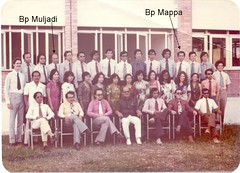
The teachers in 1978(??). I remember many of them fondly, but since this blog is about the bapaks, I won't mentioned the others here individually. (Pic courtesy of Shema)

One bapak was my homeroom ‘P’ advisor, Bapak Muljadi, a Javanese for sure and no, he was not the singer of the song Rindu (Rindu, mengapa rindu hatiku, tiada tertahan, kau tinggalkan aku seorang…that’s Mus Muljadi). Of course initially we were calling him Mul-jadi instead of Mulyadi, not knowing the old spelling of bahasa Indonesia. He was the one who give the name Perintis to the homeroom when the word was not that well known. He can be a serious guy, this bapak Muljadi, but a very smart math wizard with multiples math workbooks to his name. He would hold math class for us, his homeroomates. He would also check on us at prep at night, and at one time, if my memory serves me right would tell those kuaci eaters (Razin??) at prep to pick up (kuteep, kuteep…..) every single kulit kuaci on the floor! No one dares to play the fool with bapak Muljadi.

And ohh, he used to try and motivate us by comparing us with Jenny; may be because he can see that she was more dilligent than many of us. He was getting into the spirit of the NEP, eh? Thanks Bapak for the many motivational talks.

Another bapak was Bapak Mappangara, who hails from Sulawesi, taught science while we were in F3 and later on taught Physics at F4. Man, he was on hell of a teacher. He definitely worked harder than us and I am glad we did very well in SRP for his sake.

For sure, everybody remembers his Hari Raya open house with all the Indonesian dishes and that tasty kicap manis! Bless you bapak for feeding us all that day. I don’t know how you and Ibu did it, I am sure you didn’t cater for that open house. I don’t know if I can handle over a 100 hungry students so used to the tasteless nasik kawah, and would devour the delicious (Indonesian) home cook as if the Dewan Makan had been closed for 2 days (sorry ladies, am referring to the guys here).
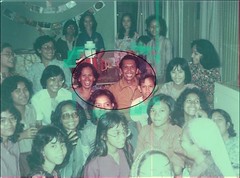
This picture, thanks to the KB76 ladies, gives me my lasting impression of Bapak Mappa. He was such a nice person beyond being a dedicated teacher (most of my teachers were). One can't help but notice how happy they were at this lebaran open house. (Pic courtesy of La)

Both bapaks were with us till we left maktab after SPM’80. But Bapak Maryoso left us for home in 1977, and home in his case is Pekalongan in Jawa Tengah. How we all wish then that he would continue teaching us, and I believe he gave us his reasons for returning home and I guess that reasons would have eluded me at this moment. But beyond that how I wish I had kept his Pekalongan address until this day.

While I don’t remember the details, to be honest, but the farewell dinner that was held in his honour is something that will live in my mind. Tears were freely flowing that night. I was reminded by Shema recently how many cried (she did, and so too Matraman) especially when the PRamlee’s song Dimanakan Ku Cari Ganti was aired. I would readily admit that I too cried that night. I believe he was the gentlest of teachers for us to feel so strongly that night. He probably was one teacher who didn't know the meaning of the word angry or upset.
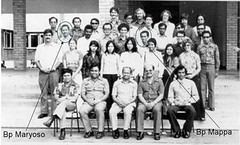
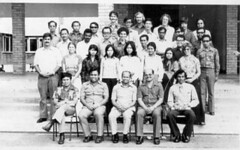
This is the only picture I have of bapak Maryoso and even this one was found floating in the internet. I ma really fond of him though I don't remember any detail beyond the farewell dinner. One may notice the many (American) Peace Corps in this pictures. I also have no recollection of his physical presence. Shema mentioned in an email that she thought he was of bigger built, and that he resembles the keroncong singing bapaks of Indonesia. What a description of bapak, but to be honest, I have no reason to doubt their singing abilities. Come to think of it, you may be right about the size! (Pic courtesy of Kb73 site)

I have traversed Pulau Jawa quite a bit while on business in the past 15 years and on two occasions I passed by Pekalongan, a town very well known in Indonesia for its batik. At that point, I looked out the train’s window and wished that I have Bapak Maryoso’s address. I definitely would have visited him. A Javanese friend Tjipto told me a few times to write to the newspaper so that he can be traced, but that was years ago and I have not gotten around to doing it.

Pekalongan and batik Pekalongan. Click on the map for a clearer view of the location of Pekalongan.

Last night my brother offered to contact his teacher friends in Java to locate bapak. May be I should be contacting my own teachers here in Malaysia if anyone knew his whereabout. In fact if anyone knows the whereabout of my three bapaks, please let me know. I would love to meet up with them again.

Unfortunately I don’t have any picture taken with them. Cameras were hard to come by in those days. And whenever one was available, normally we would always take pictures just amongst us, and non-living buildings, rather than with our teachers. Well, that was the selfish side of us then, not realizing that our teachers are an important part of our treasured past!

Tags: bapakmappamaryosomuljaditeacher
Friday April 13, 2007 - 09:35am (SGT) Permanent Link | 6 Comments
From Peasants to International Traders?

Prologue

I remember writing an article as an assignment by Cikgu Nik Man while we were in Pasteur 4. It is titled “Faktor-faktor Kemunduran Orang-orang Melayu”. In this paper I had included a climatic factor as a reason for the above topic. I guess this was the first paper I did that was properly researched and carefully referenced, complete with bibliography. I found that during the Malacca Sultanate, the Malays were not merely peasants, but were traders themselves. I asked for it back after it was marked by him but unfortunately the paper was lost.

I did a paper on the ethics of the affirmative actions in my MBA's Ethics class in 2004, not knowing of what else to write obviously. (Another topic that I was interested in my younger days was the Malay psyche - why the Malays really love to enjoy ourselves. Just look at the fiesta, and jomheboh concerts etc etc. and how many articles I have on music and songs!)

This paper written by the former rector of Institut Teknologi Bandung (the most prestigious of all of Indonesians tertiary education and I am sure ITB has no plan to change its name to Universitas Teknologi Bandung which would surely be done if it were in Malaysia) caught my attention years ago. I read this paper more than 12 years ago and the paper is still kept in my files after all these years. I thought I had said something similar twenty five years ago, but Prof Alisjahbana went one step further in noting that in a simulated environment of high-rise air-conditioned office that we have now, people everywhere are the same and nothing should stop the tropic people from being the global men. That, I believe differentiates between a real professor and a pretender!

Affirmative Action for Indonesia? – Prof Iskandar Alisjahbana, former Rector of ITB (1995, Asia Inc)

I USED TO WONDER why our part of the world was less developed than temperate climes. Finally I realized that it's because the Malay Archipelago is peopled by tropical men whose behavior is dictated by environment. The Europeans and Chinese had to fight for survival, but here the climate is fantastic. Nobody has to 'save for 'next winter; there's all the food you want.


Tropical men couldn't compete when Chinese immigrant arrived. They were self selectedfew – people of imagination, spirit and diligence – who had the courage to leave their villages. During the colonial period, the Dutch used the Chinese to divide and exploit Indonesians. Chinese got the promotions and development opportunities because they were more clever and as they became richer, our hatred of them grew.

When independence came in 1949, the government vowed to end discrimination, but change comes slowly. After a decade of sovereignty, roughly half the final year students at the Bandung Institute of Technology were Chinese. So it was not surprising when on May 10, 1963, a riot swept the campus. Chinese were beaten and their motorcycles burned.

At that time, every student wanted to fight for the nation; nobody ever said he wanted to become rich. But the way to prevent another riot was to make the indigenous Indonesians as rich as Chinese Indonesians. Indonesian’s tropical men had to become capitalists.

Because American universities are good at creating leaders, I searched there until I found a company that gave achievement motivation training to black businessmen so they could compete with whites. I liked the bidea, so with financial backing from the chief executive officer of an Indonesian bank, I hired them to help me start similar training here.

I wanted to the ITB from a place that turned out degree conscious intellectuals into an institution that produced capitalists who could create employment and make others rich.

When I became dean of the university I tried to get the other departments involved, but the oppositions was intense. Javanese think it’s rude to talk about money.

Today the ITB students who benefited from economic motivational training wnad who took calculated risk are rich. Minister Transmigration Siswono Yudosodo was one of the student leaders during the riots. Former ITB students Fadel Mohammad manufactures much of Indonesia’s airport facilities. Dedy Panigoro own hotels and is president of his own oil company.

I feel that Indonesia needs a US-style affirmative action program. This is the kind of positive discrimination Malaysia initiated with its New Economic Policy. When Mahathir Mohamad published The Malay Dilemma, he was criticized, but he knew some racial discrimination would necessary to level the playing field. Chinese already owned Singapore. If things continued apace they’d own Malaysia, too. The government subsidies upset Chinese, but if it hadn’t increased the Malay share of corporate wealth, there would have been riots.

There’s no difference in human stimulation anymore between Munich winter and a Jakarta summer. Inside an insulated high-rise office building, people are all the same. With the right training and proper motivation, the tropical man of today can be the global man of tomorrow.

Tags: malayaffirmativeactionsindonesiaalisjahbanaitb
Saturday April 7, 2007 - 10:44pm (SGT) Permanent Link | 0 Comments
So you want to do a PhD?

While I was working in Houston some years back, I have a good friend by the name of Dr Saby Sen. He had just joined the Houston office when I were there. Saby and I got along just fine. Funny guy this Dr Sen – when he introduced himself for the first time, he mentioned that he has a sister by the name of Sushmita (Sen and I am sure you Bollywood fans would know her well). I knew he was pulling my leg, but I went along with it.

So last year when he emailed me after losing contact for nearly 7 years, I jokingly asked him about his sister Sushmita. He replied, “Rahman, I have a confession. Sushmita isn’t really my sister.” He must have thought that I had fallen for his joke. I didn’t actually. Of course I knew all along he didn’t have her as his sister (at least not the Sushmita we all knew) eventhough they share the same surname. Otherwise I would have asked him to introduce me to her! On the same breathe, someone in the Houston office asked me if I am related to (the late) Rafiq Hariri, then the Lebanese Prime Minister. My response was simple, “If I am related to him, chances are that I may not be working for this company and we may not have this conversation!” Hah, someway to strike a conversation with your new colleagues, right? Of course I enjoyed my tenure at Hyprotech and I thought it was one of the best run small company in the world, but you know me and my convoluted way of answering a simple question!


The sister that never was for Saby (Left) and the relative that never was for me (right). On second thought, just may be that Dad has slight resemblance to Rafik Hariri, if only in size. But then again, most likely not. We don't have any blood from the Middle East at all. May be a little bit Indian (the bulk from Pagar Ruyung & Aceh - in fact I believe the Indian blood came from the Aceh side), but definitely not from Middle Eastern for our family.There is a better chance that I am related to Sushmita than to Rafik Hariri!

Actually that was not the reason why I wrote this piece. One day I asked him,”Saby, do you think I can do a PhD?” His response was straight forward. “Rahman, anyone can do PhD, if they are willing to take poverty!” He went on telling me what he went through while doing his PhD.

I smiled while listening intently to his story. I know what he was talking about. In the US there is no PTPTN or MARA and is not easy to get government scholarship (you can get loans tho). You would probably need to supplement your income by teaching or tutoring. You can forget the luxury of life while you are doing your PhD.

Matjepun has been pushing me to do my PhD. "You should," he told me, "it is easy and I am sure in 2 years you will have the title in front of your name." “Give me half an hour of your time, I will explain all that you need to do to get your PhD,” he added, while we were both seeping teh tarik at the cafe in Bank Negara. I am sure it is nice to have that title in front of my name. Dr Rahman Hariri..hmmm, there is a nice ring to it. It would surely be nice to see that on my credit card, right? Then again, may be not. I can’t afford poverty. In which case, I will not have a credit card to begin with! I might as well settle for the title Pak Guru from my clients and students from Pertamina! That is good enough I guess.

So recently I had a chat with my partner-cum-advisor-cum-friend, Peter. This guy has two masters degree – in Math and in Chemical Engineering, and and he used to teach at Institute Of Gas Technology in Chicago and currently like me, semi-retired, and he is old enough to be like a father figure. Being American, of course he is biased towards the American PhD compared to say British. But he has his points. If I were to consider doing it, I am more inclined to the American system, to be honest. I have read the book So You Want to get a PH.D. by Dr Kamarul Zaman Ahmad. (The book is not convincing to be honest. For a book written by a PhD graduate (a UM lecturer at that) for prospective PhD students, it is not scientific and based too much on hearsay.)

But in any case, he did explain the difference between UK PhD and US PhD, noting that UK PhD is more unstructured. In the US there are several taught subjects and students have to sit for exams for those subjects. Anyway, I think more highly of the US PhD and I think it is more suitable for me and is the way to go for Malaysians thinking of doing PhD.

Anyway back to getting PhD - what does it take to get one? Peter categorized them in three different types:

  1. PhD in History, Literature, social sciences etc – you need perseverance. Keep pounding on it, write a book and you should be getting your PhD. In the US you have 7 years to complete, and if you are taking PhD in these areas, you will get your PhD.
  2. PhD in Engineering – what I am targeting. Now this one is very dependent on your professor. If he can get you the funds to buy the equipment that will enable you to measure and get all the data you need for your research, then you should be ok. If not, it will be a long wait.
  3. PhD in Mathematics – this is the most difficult. You may have an inspiration and you may be able to solve the theorem in a flash and in 6 months you should get your PhD. But you may be staring at it, and pound at it for for 6 years and have nothing to show for it.

He quoted an example. I think most of us know how to solve for the roots for quadratic equation, right? Do I hear someone groaning somewhere? Hahaha, I don’t blame you for feeling that way. In any case the roots for a second order polynomials (ax2 + bx + c = 0), solving for x, one would get

Simple stuff for F3 and may be F4 for sure. This is old stuff. This solution was known by the people of the Middle Kingdom in Egypt circa 2160-1700 BC.

The same goes for cubic equation – the polynomials of the 3rd order (ax3 +bx2 + Cx + d = 0). One can find the solution to this albeit it is more convoluted, but definitely doable. But it is too lengthy for this blog. Visit this site to know more.

My point is, mathematicians have found the roots up to the polynomial of the 4th order (quartic equation). However, scholars including PHD students had been working hard at solving for the roots for the 5th order polynomials, the quintic equation. Afterall, if there are roots from second to fourth order polynomials, surely it was a matter of time before someone break the code for the quintic, right? Well, for 350 years they tried and if we were one of the PhD students hoping to solve it for our PhD, well, bad luck my friends.

Quintic equation can’t be solved algebraically. It took Abel’s Impossibility Theorem (1826) ( and also by Galois independently) to prove that it can’t be solved and I guess one can be awarded a PhD for proving wrong what was thought for 350 years to be solvable! But for the rest of us mere mortals, well, you have just 'wasted' 7 years of your life!

Ah well, I don't have 350 years to get this title. I Think I will settle for the simple En Rahman/Pakcik Man/Abgman. Or better still just call me Rahman.

Tags: phdpolynomialssushmita
Tuesday March 27, 2007 - 10:02pm (SGT) Permanent Link | 0 Comments

Wednesday, March 28, 2007

So you want to do a PhD?


While I was working in Houston some years back, I have a good friend by the name of Dr Saby Sen. He had just joined the Houston office when I were there. Saby and I got along just fine. Funny guy this Dr Sen – when he introduced himself for the first time, he mentioned that he has a sister by the name of Sushmita (Sen and I am sure you Bollywood fans would know her well). I knew he was pulling my leg, but I went along with it.


So last year when he emailed me after losing contact for nearly 7 years, I jokingly asked him about his sister Sushmita. He replied, “Rahman, I have a confession. Sushmita isn’t really my sister.” He must have thought that I had fallen for his joke. I didn’t actually. Of course I knew all along he didn’t have her as his sister (at least not the Sushmita we all knew) eventhough they share the same surname. Otherwise I would have asked him to introduce me to her! On the same breathe, someone in the Houston office asked me if I am related to (the late) Rafiq Hariri, then the Lebanese Prime Minister. My response was simple, “If I am related to him, chances are that I may not be working for this company and we may not have this conversation!” Hah, someway to strike a conversation with your new colleagues, right? Of course I enjoyed my tenure at Hyprotech and I thought it was one of the best run small company in the world, but you know me and my convoluted way of answering a simple question!

The sister that never was for Saby (Left) and the relative that never was for me (right).
On second thought, just may be that Dad has slight resemblance to Rafik Hariri, if only in size. But then again, most likely not. We don't have any blood from the Middle East at all. May be a little bit Indian (the bulk from Pagar Ruyung & Aceh - in fact I believe the Indian blood came from the Aceh side), but definitely not from Middle Eastern for our family.There is a better chance that I am related to Sushmita than to Rafik Hariri!

Actually that was not the reason why I wrote this piece. One day I asked him,”Saby, do you think I can do a PhD?” His response was straight forward. “Rahman, anyone can do PhD, if they are willing to take poverty!” He went on telling me what he went through while doing his PhD.

I smiled while listening intently to his story. I know what he was talking about. In the US there is no PTPTN or MARA and is not easy to get government scholarship (you can get loans tho). You would probably need to supplement your income by teaching or tutoring. You can forget the luxury of life while you are doing your PhD.

Matjepun has been pushing me to do my PhD. "You should," he told me, "it is easy and I am sure in 2 years you will have the title in front of your name." “Give me half an hour of your time, I will explain all that you need to do to get your PhD,” he added, while we were both seeping teh tarik at the cafe in Bank Negara. I am sure it is nice to have that title in front of my name. Dr Rahman Hariri..hmmm, there is a nice ring to it. It would surely be nice to see that on my credit card, right? Then again, may be not. I can’t afford poverty. In which case, I will not have a credit card to begin with! I might as well settle for the title Pak Guru from my clients and students from Pertamina! That is good enough I guess.

So recently I had a chat with my partner-cum-advisor-cum-friend, Peter. This guy has two masters degree – in Math and in Chemical Engineering, and and he used to teach at Institute Of Gas Technology in Chicago and currently like me, semi-retired, and he is old enough to be like a father figure. Being American, of course he is biased towards the American PhD compared to say British. But he has his points. If I were to consider doing it, I am more inclined to the American system, to be honest. I have read the book So You Want to get a PH.D. by Dr Kamarul Zaman Ahmad. (The book is not convincing to be honest. For a book written by a PhD graduate (a UM lecturer at that) for prospective PhD students, it is not scientific and based too much on hearsay.)

But in any case, he did explain the difference between UK PhD and US PhD, noting that UK PhD is more unstructured. In the US there are several taught subjects and students have to sit for exams for those subjects. Anyway, I think more highly of the US PhD and I think it is more suitable for me and is the way to go for Malaysians thinking of doing PhD.
Anyway back to getting PhD - what does it take to get one? Peter categorized them in three different types:

  1. PhD in History, Literature, social sciences etc – you need perseverance. Keep pounding on it, write a book and you should be getting your PhD. In the US you have 7 years to complete, and if you are taking PhD in these areas, you will get your PhD.
  2. PhD in Engineering – what I am targeting. Now this one is very dependent on your professor. If he can get you the funds to buy the equipment that will enable you to measure and get all the data you need for your research, then you should be ok. If not, it will be a long wait.
  3. PhD in Mathematics – this is the most difficult. You may have an inspiration and you may be able to solve the theorem in a flash and in 6 months you should get your PhD. But you may be staring at it, and pound at it for for 6 years and have nothing to show for it.

He quoted an example. I think most of us know how to solve for the roots for quadratic equation, right? Do I hear someone groaning somewhere? Hahaha, I don’t blame you for feeling that way. In any case the roots for a second order polynomials (ax2 + bx + c = 0), solving for x, one would get


Simple stuff for F3 and may be F4 for sure. This is old stuff. This solution was known by the people of the Middle Kingdom in Egypt circa 2160-1700 BC.

The same goes for cubic equation – the polynomials of the 3rd order (ax3 +bx2 + Cx + d = 0). One can find the solution to this albeit it is more convoluted, but definitely doable. But it is too lengthy for this blog. Visit this site to know more.

My point is, mathematicians have found the roots up to the polynomial of the 4th order (quartic equation). However, scholars including PHD students had been working hard at solving for the roots for the 5th order polynomials, the quintic equation. Afterall, if there are roots from second to fourth order polynomials, surely it was a matter of time before someone break the code for the quintic, right? Well, for 350 years they tried and if we were one of the PhD students hoping to solve it for our PhD, well, bad luck my friends.

Quintic equation can’t be solved algebraically. It took Abel’s Impossibility Theorem (1826) ( and also by Galois independently) to prove that it can’t be solved and I guess one can be awarded a PhD for proving wrong what was thought for 350 years to be solvable! But for the rest of us mere mortals, well, you have just 'wasted' 7 years of your life!

Ah well, I don't have 350 years to get this title. I Think I will settle for the simple En Rahman/Pakcik Man/Abgman. Or better still just call me Rahman.

EPILOGUE

Originally Posted at Time in a Bottle
Tuesday March 27, 2007 - 10:02pm (MYT)

Saturday, February 17, 2007

Senjakala, Senjakala, Mari Kita Pulang


I was tending my garden today at around 7 pm when suddenly I have an audio flash back - this tune came haunting me. I think I learned this song while I was in standard 2 in SRJK Lenggong (1971).

Senjakala, senjakala
Hari sudah petang
Malam sudah datang
Siang sudah pergi
Sekarang kita pulang
Esok datang lagi
Senjakala senjakala
Mari kita pulang

Mind the lyric, ok - it has been nearly 36 year. I must have missed a word or two – make it a para or two. Anyone out there who can complete the lyric for me?


Yes, sunset can do this to you. For me, my best memory of sunset is with my aruah Bapak. Coming back from school holiday in 1979, aruah and I used to jog along rubber plantation behind our rented house in Bukit Chandan Kuala Kangsar. (We had moved to KK from Taiping in late 1978). We climbed up some hills and from on top of one of the hills, one could see an amazing view – the golden dome of the Ubudiah Mosque, the golden dome of Istana Iskandariah with its minaret, and the brownish - make that golden too, water of Sungai Perak - flowing lazily, all in the splendour of a golden sunset.
Picture perfect!

So there we were, staring dreamily at the Arabian fairy-tale view basked in the golden hue until it passed us by and was replaced by a reddish tint. It was an out-of-this-world scenery; or at least out of Malaysia. We didn't say anything - just absorbing the view in front of us.

These pictures do not do justice to what we saw basking in the splendour of the golden sunset (Ubudiah mosque with the Sungai Perak on the foreground (Left), while the Iskandariah Palace on the right. I believe both architecture are Moorish. Bapak and I were teleported to the 1001-night era that evening. Oh by the way, they are my two kids and one of my fav niece in front of Iskandariah.

I would love tracing back the path we took and take some photos. I am sure more hills have been cut for yet one more housing development, but I am keeping my fingers’ crossed. Kuala Kangsar and Taiping are pretty much sleeping hollow. May be I will still have my chance!
Anyway, back to the song, there is another song that I remember singing during a scout’s jamboree at the Padang, in front of the school in Lenggong. I think it is a Kedah folk song.

Tunang dia dok pi tang mana
Dok tengok tak dak
Cuba hang tengok
Cuba hang tengok
Depa suruh hang pi tengok di kedai
Tu dia, dia dok mai
Tu dia, dia dok mai
Dok mai, hang kata tak mai

What were us kids, in a remote town near the Perak River and Tasik Chenderoh, just 50 km from the black area of Keroh, near the Thai border, in the early 70s - when the communist insurgencies were still rampant, doing, singing a Kedah folk song? And for that matter, singing about someone else's fiance at that? I don't have the answer, but I know it was fun - the song was catchy and funny.

How about a Siamese song then since we were that close to the border? Sure, we were taught that too!

Sawasdee Te Chan
Rama Po Chan
Tekap Chan
Sawasdee

I told you I am an overpaid time traveller!
EPILOGUE

Originally Posted at Time in a bottle
Friday February 16, 2007 - 07:48pm (MYT)

Wednesday, February 7, 2007

This used to be my playground


How do you motivate the internet-era child to give boarding school a try?


It was so easy then. In the 70s, it was every school children’s dream to go to a boarding school, including yours truly. MCKK was top of the list then for every boy while Tunku Khursiah was every girl’s dream. But you need to get 5As in Penilaian Darjah 5.

During those days, in King Edward VII-1 primary school in Taiping, only one student got 5As (Zakri Mohd Khir, my best friend) to qualify for MCKK and another got 4As (Cheong Gim Leong), and may be another 5 got 3As, including this writer, unlike nowadays may be the whole school could get 5As. So how did mere mortals, like this writer, get into boarding school?

SRJK King Edward VII-1 Taiping where this writer kicked his first rugby ball. I love KE and the oldcolonial school building. It's very grand with the century old raintrees on the side. It's so green and shady unlike MRSM KB which is so barren. Then again, this is Taiping - the wettest town in Malaysia.

When a teacher dropped by in our Std 6 class to announce about MRSM entrance test, the reaction was,” MRSM? What’s that?” But for someone who had announced his intention that he was going to a “sekolah asmara” (and I were relentlessly teased by my sister for that gaffe), that was a dream come true.

We had to sit for the exam at one school, somewhere near Kg Boyan, I think. (Do you remember exactly where, Aya?) The exam started just before zohor – I remember that well because aruah Bapak insisted that we performed the prayer first. To be honest, I was furious with him as I was 15 minutes late for the exam. But no problem, they let me sat for it without any hassle. And in hindsight, aruah Bapak was so right, as always. Yes Sir, I should have known better.
I was told later by him later that I came out 4th in the exam that was sat by students from the whole district of Larut Matang – he has his way to find out, being a government officer at Taiping's District Office. He also told me that two girls were ahead of me – could you be one of them, Aya?


Back then, the motivation to go to a boarding school was great. It was so prestigious to go to one – for the student and the family. You can perhaps count boarding schools with your fingers and year in year out you would hear how well they (the boarding schools) would do in LCE/SRP and MCE/SPM. I am sure aruah Bapak and Mak wanted it as much as I did.

Aruah Bapak and Mak had always emphasized on education for all their kids. They may not be university graduates themselves but aruah Bapak passed his senior ‘Cambridge’ and mum, despite the fact that she didn’t finished her high school, was better educated in English Literature than this writer!

I come from a family of 13. Now that’s one big family even by yesteryears’ standard. But in 1975 (when I was in Std 6), there were only 9 of us. While typically one would think that it was a bit crowded, that was not the case, as I remember it. We stayed in a reasonably-sized government bungalow with big compound - big enough for 5 rambutan trees, 2 mango trees, and 2 durian trees. We can play football and rounders with three rambutan trees and a mango tree forming the four bases. (For some reasons, the compound was within the Aulong Police Station so it was very secured with Police Sentry saluting us whenever we go home, until about 1978 I think when it was demarcated.)

I must also add that we could see the tin dredge from our living room - may be about 500 m away from our house. The tin dredge was a sight-to-behold at night, due to its bright lighting especially against the dark Maxwell Hill with its flickering light at the top as the backdrop.

Tin Dredge – This is not the one in Aulong, unfortunately. It was dismantled and the tin mine is a now housing area

So family or space was not a motivation for me then. I was sharing a room with a brother, and I think I could have studied at home without much problem. The only ‘problem’ could be noise as many of my siblings were small, and I believe we even have a baby sister that year. May be, but definitely it was the prestigious thingy that got me going. (Of course then MRSM was an unknown entity until KB76ers came along! , masuk bakul ni.)

I am sure that facility-wise, MRSM KB had so much more facilities than aruah Bapak or SM King Edward VII could provide. The teachers had been excellent, and the competition provided by my schoolmates were great. In hindsight, I would not have it any other way.


SMJK King Edward VII – my school for 3 weeks while waiting for my date with destiny on the 24th January 1976


I don’t know, what else could be our other motivations then to go to boarding school? May be someone can enlighten me. Li, Shema? Suri perhaps?

Anyway, back to 2007, the situation is so much different. MARA have about 40 MRSM throughout Malaysia, and I am sure the Education Ministry have more boarding schools. It is no longer as prestigious now as it was back then to go to boarding schools.

With his own room, computer, and internet connection 24/7 and his mother, always at his behest, it is difficult to convince Arif that he should give MRSM a try and queue to take his bath and for food and do his own laundry. “What about my piano exam in June?” he asked me. No, he has yet to find out about the laundry. “I’ll go and pick you up from MRSM the day before the practical”, was my reply. “Are you sure there is a piano for me to practice in MRSM?” he retorted. Well I remember us singing along lagu Maktab during assembly with Doris playing the piano (and Kak Rosilawati conducting, as if we were all graduates of Julliard or Berkerly and knew how to interpret her hand waves!) during those days, so there must be one. Wishful thinking on my part, I must admit.

Another potential problem for him is food. For someone who does not eat rice, and would need his daily doses of cheese and pizza, that will be his biggest headache. Especially that Pengkalan Hulu is really far from civilization and civilization in this case is Domino’s or Pizza Hut, from Arif’s perspective.

He will also be missing the opportunity to fly his RC on the weekend. I have told him his brother and I would take over and fly it for him, much to his chagrin!

I really want him to go - to be independent (he is 16 this year, 3 years older than I was when I went to Kota Bharu), and to be able to compete with the really good students. He needs the competition. It is time for him to get out of his cocoon and experience the world.
Of course the teachers are very motivated to get the best out of each student. I know that and I had experienced it. And I know Arif needs that, a lot. He said so. So MRSM would be perfect for him, from this perspective.

He has had some advice from Cikgu Dr Fatanah during the Raya open house recently. I am sure her words would stick to his mind – give MRSM a try.


Cikgu Dr Fatanah with Arif. She is my former Geography teacher, and former Pengetua MRSM Jasin and a recipient of Maal Hijrah award at the national level in 2002. She was seen here discussing Arif's options to him - to go or to not go..

I know I will miss him and so will his brother and mum, but like Sting says, if you love somebody, you must set them free! I hope he is right.

I don’t know much about MRSM in 2007. My view of MRSM was that of my experience in the 70s and it may be distorted by now. I am sure it has changed but I am sure in the quality of education, it has not.

Tuesday, February 6, 2007

From Lhokseumawe to Malaysia's Favourite Son


You know, while overseeing Arif assembles his new ARF radio-controlled aircraft, I was also watching another-one-more-anugerah-so-that-everybody-will-at-least-get-one award ceremony on TV3 last night. Not that I care much about it or who won or lose in this far-too-many awards for our tiny-dead-and-boring entertainment industry (hey, our new movies are lousy and our new songs suck, big time!), but a tribute to P Ramlee – with Ramlah Ram and co. singing his song “Inang Baru” which won him the best song in a film at an Asian Film Festival in the 50s, caught my attention when Ogy mentioned his name "Tan Sri P Ramlee".


I brought this up in the NST in 1990 in a letter to the editor, which was published but was of course edited out, so the message was lost. P Ramlee was awarded an AMN in his lifetime and posthumously awarded the title Tan Sri by our Yang Di Pertuan Agong (the current Sultan Perak) in 1990. Yes, I was pleased; he deserves it. But I will ask the same question again 16 years on – why couldn’t the power-that-be confer him the title Tun?


I don’t think I am exaggerating if I were to say that we Malaysians live and breathe on his films, and songs. Where would we be if not for him? My siblings and I cycled to our nenek's house on the other side of Aulong every Friday night, so that we could watch his movies in the 70s - I think I told you we had no TV then. We laugh at his antics in Ali Baba, Labu Labi, and Bujang Lapok, we cry with him in many of his movies. To us, he was Amran, the trishaw man (Penarik Beca), Hassan the orphan (Anakku Sazali) and Kassim Selamat, the saxophone player (Ibu Mertuaku) and we can relate with their characters and predicaments. Our hearts are tinged with sadness whenever we listen to “Dimanakan ku cari ganti” or “Dendang Perantau” and the many hundreds of his songs.


My kids are all hooked on with his movies – three generations apart. Which kid does not, anyway? My North American friends were asking me last week if I could get them the movies on DVD – when I took them to Saloma’s Bistro at Jalan Ampang for dinner.


Now tell me, how many politicians, and businessmen carry the title Tan Sri? Can we said in the same breath that these people - with due respect to them, that they are P Ramlee’s equals (in whatever field that they are/were in)? Or if they have done more that what P Ramlee has done to the common folks of Malaysia? One veteran singer I like has a Tan Sri title. Great, rightly so too, but again, is he anywhere in the league of P Ramlee?


I wonder if Malaysians, young or old, know anything about the other Tan Sris that we have? From Wikipedia, I am told that there can be 325 living Tan Sris and only 25 living Tuns at any one time. (For some reasons, I believe we have more.) 325 living Tan Sris? How many living and dead Tan Sris do we have and tell me how many are up there with P Ramlee in our nation 50-year history?


Don’t get me wrong. Whatever the reasons a Tan Sri is given to anyone, it is not for me to question it - at least not in this blog. (That my friends, deserves another full fledge treatment on its own.) But P Ramlee deserves the highest honour our small nation can give to her most treasured and illustrious son.


We mention his name at every award we organize. Many singer would do a cover version of P Ramlee’s songs at one time or another. Some singers, like Sheila Majid, would even do a full tribute. But I think that’s not good enough.


Yes, he is in the people’s hearts, but as a nation, we need to show that he is above the many politicians and businessmen with Tan Sris that we have. He should be Tun P Ramlee. Period!


By the way, Rita (Rudaini), I do have a moustache. In fact I will do one better – I have a moustache and a goatie!


Monday February 5, 2007 - 05:06pm (SGT) Edit Delete Permanent Link 0 Comments

Sunday, February 4, 2007

Don't get me wrong - I love nucleur energy


I was all eyes when I read the following anecdotes from Gurmit Singh published in the The Sun yesterday.


A cyclist can travel about 5 km on the energy of one egg
A person walking would require three eggs to go the same distance
A loaded bus requires the equivalent of about two dozen eggs for each person it carries for 5 km
A typical car requires the equivalent of seven dozen eggs to carry one person 5 km
Even if you double the fuel efficiency of the car, and double the occupancy, the car would still use the equivalent of 21 eggs to make the trip – more than 20 times a bicycle


I don’t know if that will give you a picture that all of us can visualize and understand. An American friend of mine was telling me how his son was not able to comprehend it if he were to tell him (his son) that it costs him such and such dollars to send him (his son) to the university every year. His son didn't have the feel for the numbers. Then, he started telling him that yearly it cost him one ‘car’ to educate him and the end of each year, he would just take the car and ramp it against a concrete wall and totalled it and then replace it with a new car each year. Now, for a teenager in the US, that is a lingo that they can comprehend. They know the value of a car. (Although it backfired on him when his son asked him to buy him the car instead of going for the degree!)


Hopefully the eggs will do it for us here.


Let me tell you this.


It is not the Malaysian culture to walk or jog or cycle. (“Hahaha, that fat guy is trying lose weight", you would hear them whisper if you were to jog or “That family must be very poor for not having a second car. His wife had to walk to the shop. Pity her for marrying that poor guy.”)
We park our car at the nearest point to the entrance, or elevator. If we could park our cars inside our offices, or home, or shops we were going to, trust me we would. We would go round and round the block to find that nearest parking spot. (if we can't find it, then we double park!) When we visit someone, we would prefer to park our car in front of his gate. If his is not available, his neighbour's gate would be a good alternative! The objectives are two folds: show off our gleaming new car, and walk less.


We don’t climb stairs. We prefer to exercise our index finger by pressing the button so that the little steel box will take us one floor down. Yes, one floor down!


We complain about hot KL is nowadays and how things were much comfortable in the old days. What do you expect when we have created micro-climate in our cars, homes and offices with our airconditioner? Do you expect our environment will get cooler this way? A favourite question in first year chemical engineering exam – Can you cool down your room by using a refrigerator?


Explain.


That bulge on your stomach or the spare tyre is a sign of prosperity, and proud of it.
But don’t blame ourselves only, the responsibility lies too with the city planners (read: government) to create a conducive environs for all of us.


KL is not meant for walking. You will shorten your life span if you were to do that – pollutions, motorcyclists


And if you think our suburbs are any better, your are sadly mistaken. They are not meant for walking either. In my neighbourhood, you have to start your car to drive your kids to school 400 m away, you drive to the mosque 100 m away and you drive to the shop 900 m away. Prof Tajuddin (the maverick architect from UTM’s School of Architecture), you are so right!
Housing developers will go at length to sell you a house with a porch that can fit in two cars side by side, even if that is the only reason to buy the house. And as if that's the only reason you and I buy houses - for our cars. Nevermind the location, the location or the location of the house - noting the mantra of the properties guru.


There is a reason why they did that. The government wants you to buy more cars so that you pay more taxes. They can't tax you for walking.


I don't think I need to list down what are needed for our suburbs. That has been discussed by many like Dr Tajuddin. Let me end this with another quote that will give us some perspective of the title I had chosen for this piece.


"Dont get me wrong. I love nuclear energy! It's just that I prefer fusion to fission. And it just so happens that there is an enormous fusion reactor safely banked several million miles away from us. It delivers more than we could ever use in just about 8 minutes. And it's wireless!"
William McDonough, Fortune Brainstorm Conference, 2006


Tags: social Edit Tags
Saturday February 3, 2007 - 10:22am (SGT) Edit Delete Permanent Link 0 Comments

Thursday, February 1, 2007

Much Ado about English


Did you read about the study conducted by Monash University which concluded that one third of Asian students graduating from Australian Universities have such poor English skills they should have never been admitted in the first place? It was reported in an English language tabloid yesterday.


I was only 18 years old when I went to Australia for my degree in 1981. Prior to this, I was educated in the Malay medium - where everything, except English, was taught in Malay. (English was of course taught in Kelantanese! ) We were the first batch of kids in the nation to go through a full 11 years of education in Malay in totality, unlike the previous batch lucky enough to have a choice to either go to English or Malay medium school.


Studying for the matriculation in Perth at Leederville Technical College, one had to take English Literature as a subject. Yeah, it was all about Shakespeare and literature review. We had to read and discuss classic Australian novel like The Chant of Jimmie Blacksmith and My Brother Jack or simply classics like The Outsider by Albert Camus and act on Macbeth with its old English lingo.


I would be the first to admit, no matter how embarrassing it can be, that I had difficulty trying to read and understand those novels, and let alone be able to intelligently discuss and bisect them in class. I remember vividly how one day, the English teacher, Mr Sean, would call upon me to discuss on the indifferent attitude of Meursault in The Outsider. As the clock ticks - minutes seems like hours, the class went into silence as I kept quiet with my head bowed down in shame, not able to say anything intelligent. I couldn’t even tell him, ‘Sorry Mr Sean, but I couldn't understand the storyline at all.” That was the last time he ever asked me of anything. I just hope that Abu and Ime (Rahiman) would not remember that incident.


Well, I survived the matriculation to be able to study engineering at Monash, but I have to admit, barely. It would be too embarrassing to publish what I got for my final - for sure it was less than my age. For sure they didn’t admit me on the basis of my ‘excellence’ in English Literature.


Worst was to come. I simply could not understand a single lecture that I attended. Don’t get me wrong. I was the kind of student who would attend every lecture religiously and not the kaki ponteng type. It was one thing to try to understand the technical aspect of the lecture, it was totally another to decipher the accent of the lecturers. So my studies deteriorated rapidly, so much so I was even called to the Dean’s office and was warned that I would be kicked out if I didn’t improve in the next test. I guess I was on the Dean's Lists, eh?
First term exam didn’t help either. A check at the results board revealed my exact position in the ranking of the first year students (which include our very own best student, Rashid Mohd Nor) in the faculty – second, from the bottom, that is!


What do I do? I was heading nowhere. The subjects were on a totally different level that what we had at SPM and Matriculation level. The only decent thing to do now was to see the Malaysian Consul in Melbourne and seek her permission to pursue my studies in Malaysia where language should not be a problem for me. Next was a phone call to my sister asking her to get University Malaya’s admission forms.


By chance, I met a senior who was in his second year in electrical engineering and explained to him of my intention. Being the nice guy that he is, he took it upon himself to give me extra classes in physics, chemistry, and the engineering subjects and patiently handhold me. With the basic understanding on the subject at hand, going to the lecture hall was no longer a chore. In fact, I was beginning to enjoy momentum transfer and vibration analysis and their G’die-mate accent and no-worries attitude.


Thanks to him (one Dzaharuddin Mansor, now Dr/Prof) and his extra classes, I survived my first year engineering at Monash, which has quite a notorious drop out rate. I'm glad that I was not part of that statistic. My first year results were nothing to shout about but it was more than adequate for me to continue to second year.


I guess that was all that I need. My English was still as bad as ever, but enough to get me around talking and discussing with the lecturers and fellow students. Once I got the hang of it, I guess I breezed through the subsequent years graduating with honours in the minimum time allotted. Furthermore, in engineering, it’s more about the mathematics – the differential equations and the laplace transform. You don’t need to be a Shakespeare to understand them, may be just rocket scientist!


Another factor that helped me improved my language skills was the fact that I was practically the only Malay student in my chemical engineering class. I had no choice but to mix around with my Australian counterparts. My best friends then was an Australian (Neil Horvath) and a Singaporean (Chuan Aik), and they definitely could not speak Malay.


I don’t disagree with the finding by the don. However, you can't blame the universities. I believe it is the responsibility of the feeding school (high school) in Malaysia to ensure that students are proficient in the English language. I think it will take more than just teaching ‘English’ to our children. I think what we are doing now in teaching our science and math in English in junior high school is a step in the right direction for our children. We need to get our children to use the language in every aspect of their life and thinking, nonchalantly. Let’s not worry about the political implications and decide on what is best for the future of our children.


My elder sister, who was fortunate enough to be born a year earlier and hence went through English medium, spent her early childhood reading Enid Blyton (Famous Five, Mallory Towers etc) and of course she graduated to Mills & Boon later on in life while this writer lived on the Malay translation of ‘Alfred Hitchcock and The Three Investigator’. Jupiter, Pete and Bob became Jalil, Ah Meng and Gopal in Tiga Penyiasat! (Don't get me wrong, I did enjoy Misteri Mumia Berbisik.) I didn’t read Enid Blyton until much later.


Today I find The Outsider by Albert Camus fascinating and makes me ponder about life's absurdity as the young Mersault had experienced in the dusty streets and courthouse of Algiers and I am sure Cikgu Nik felt the same way about the book (I loaned her the book a couple of years ago). My Brother Jack was as engrossing as ever as I kept on visualizing life in interwar Melbourne compared to when I was there in the easy 80s.


While I worry about our children's language skill, which is deteriorating fast, I am aware too that I am not perfect myself. I hope that Cikgu Nik Faridah and Ms Joyce would not cringe if they were to read this – may be no spelling error with the advent of the word processor, but perhaps, God forbids, full of grammatical errors. They may disown me as a former student. Perhaps my predicament with the language may not be representative of all of my classmates who went through the same five years of education in that school in Kota Bharu. Definitely not for one Soraya Merican. She was perhaps exposed to some kind of radiations in the physic lab those days to be so good with the English language.


I wonder though that if one third of Asian graduates of Australian universities have such poor skills in English, what about our undergraduates in the local universities, right now? I would cringe thinking about it - unless of course if they were lucky enough to exposed to same radiation!


Tags: education Edit Tags
Wednesday January 31, 2007 - 09:02am (SGT) Edit Delete Permanent Link


soraya
I agree, the standard of english among our young ones are appalling. I went through a number of hair raising ( hair pulling too!!)experience during my banking days. Btw, the only harrowing experience i had in our science lab (as far as i can recall) is when the gas tube to the bunson burner exploded & singed my eyebrows & the hair off my arms...! What a fright!
Wednesday January 31, 2007 - 03:11pm (SGT) Remove Comment

Rahma…
Aha, that explains it then!I guess that must have been at the old lab at the top of the academic building, no?The gas have been left running without igniting, or something like that.
Sunday February 4, 2007 - 03:15pm (SGT) Remove Comment